
A custom web app that has run a cat-adoption center's shifts for four years
Furkids runs a cat-adoption center inside the PetSmart in Buckhead, Atlanta: a wall of seven cages, staffed by rotating volunteers across daily shifts. TiltStack built the software that runs it - a private, login-only web app where every shift becomes a structured report that reaches the right people automatically. It has been live and in daily use for over four years, serving 39 active volunteers plus the rescue's staff. This is proof of something a brochure website never shows: we build and operate real software.
At a glance
- Client: Furkids - Buckhead adoption center
- Type: Custom, access-controlled web application
- Stack: Firebase (Auth, Realtime Database, Cloud Storage, Cloud Functions), Gmail OAuth2, hand-built front end
- In production: 4+ years · 39 active volunteers · reports emailed to the full roster plus staff
The problem: shift knowledge that didn't travel
Cats come and go, some are on medication, some stop eating, and the people who need that information - the shift lead, the medical coordinator, the next volunteer - usually aren't in the room when it's observed. Before this app, reporting a shift meant a volunteer copying a text template into a regular email, filling it in by hand, and sending it out to everyone, while the volunteer list itself lived in a separate Google Sheet. It technically worked, but it was manual and fragile: no consistent format, no searchable history, no easy way to attach a photo to "this cat looks wrong," and every report depended on someone remembering to copy the template and the right addresses.
What we built
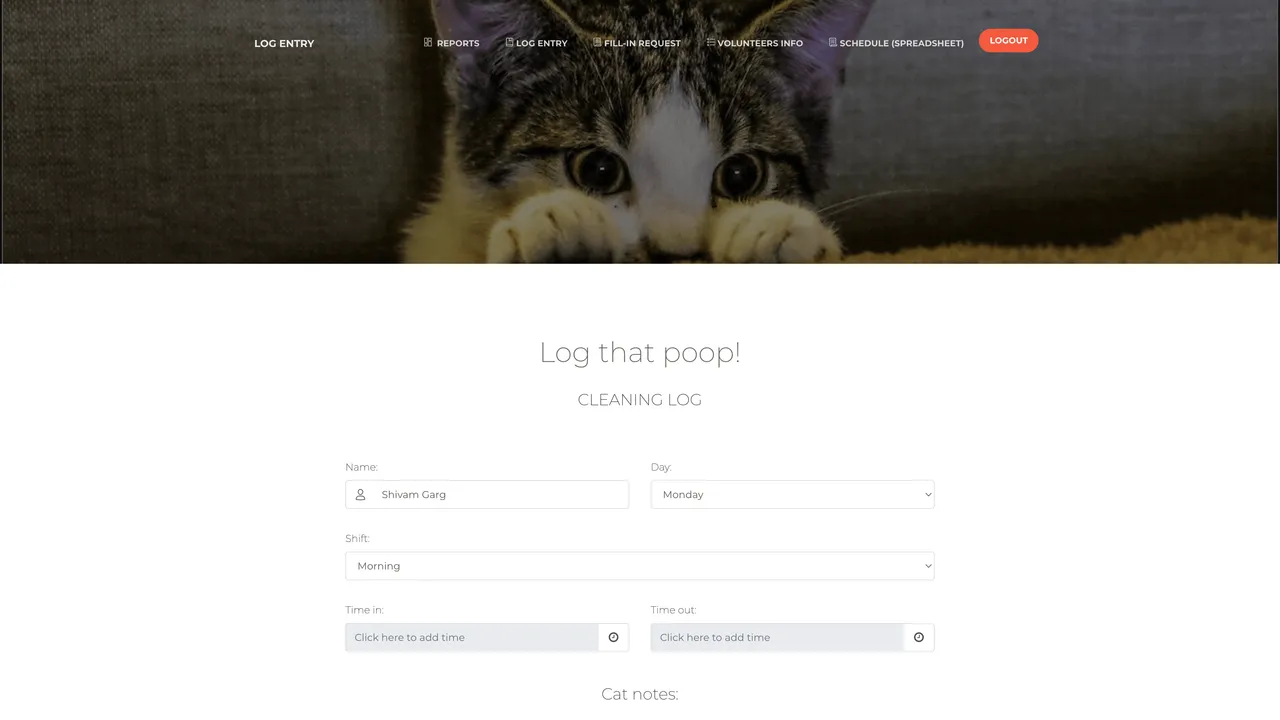
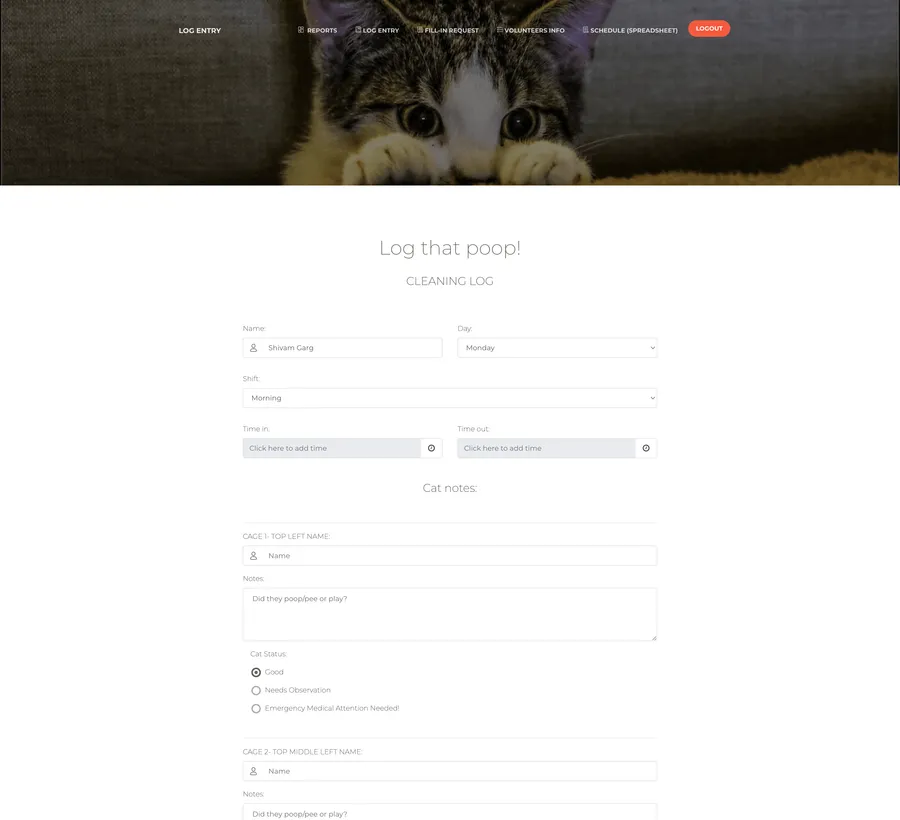
- A report modeled on the actual wall. The form mirrors the physical layout - seven cages by position, top-left through bottom-right - so volunteers log what they see with no translation. Each cage captures the cat's name, free-text notes ("did they poop, pee, or play?"), and a three-level status: Good, Needs Observation, or Emergency Medical Attention Needed - a built-in triage signal.
- Photos from a phone, straight into the report. Volunteers work on their phones on-site. Images are captured in the browser, uploaded to cloud storage, attached to the report, and embedded directly in the notification email - so whoever's triaging sees the cat, not just a description.
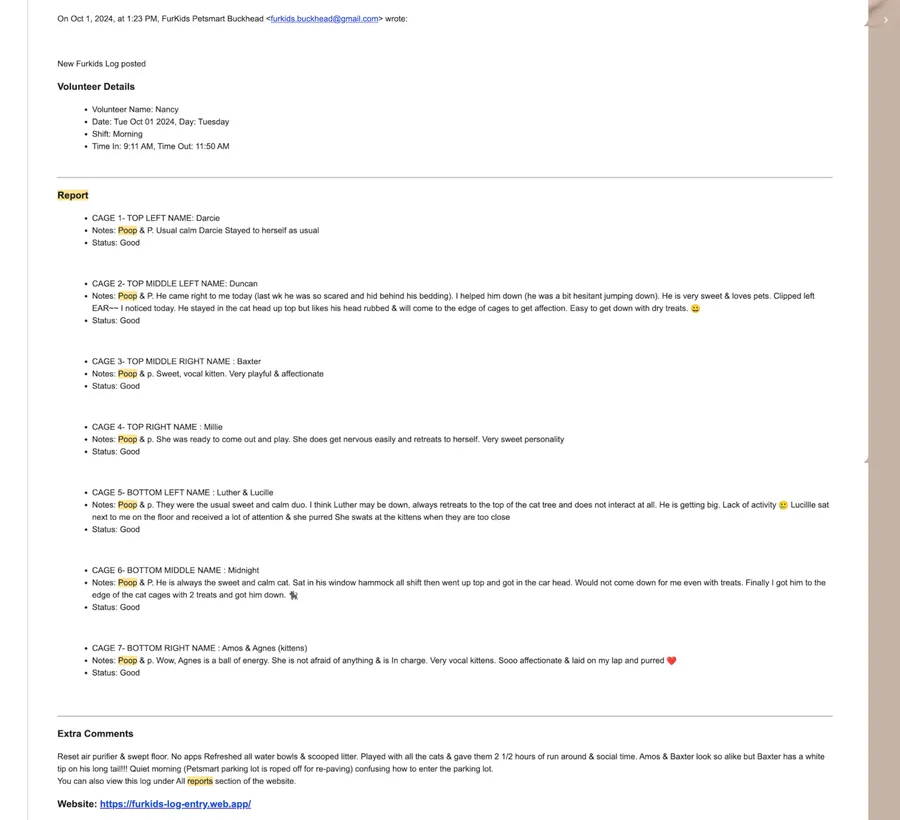
- Every report emails the right people automatically. Filing a report triggers a backend function that renders the whole shift report as an email and sends it - but only to volunteers who've opted in to receive reports, with a separate opt-in for schedule and fill-in requests. It's a real notification pipeline, not a contact form.
- Fits the tools they already use. After filing, the app hands the volunteer off to VolunteerHub - the rescue's existing hours-tracking system - via single sign-on, so logging a shift and logging hours are one motion. The master schedule stays in the Google Sheet the team already trusted.
- Browse, deep-link, and manage. Volunteers see their own reports and the whole team's, can open and share any individual report, and admins can add new volunteers - all behind authentication that refuses every read and write without a valid login.
Why it's real software, not a web page
The heart of the app is an event-driven serverless pipeline. A database write fires a Cloud Function that renders a full report and fans it out to a per-recipient, opt-in-filtered list over authenticated Gmail - a welcome email for new volunteers, a report email for each shift, a request email for each fill-in. It's a genuine access-controlled data app: real accounts, admin roles, database rules that deny everything to the unauthenticated, and indexed queries separating "my reports" from "all reports." And it runs on serverless infrastructure that costs a small nonprofit next to nothing and needs no server maintained. That combination - access control, automation, and integration with existing tools - is the line between an application and a page.
The outcome: four years of shifts that run themselves
The app has been live and in active use for over four years, with 39 volunteers currently rotating through it and reports reaching the full volunteer roster plus three staff. More importantly, information now travels the moment it's observed. Over those years the system has:
- Sent emergency fill-in requests that got missed shifts covered before a cage went unattended.
- Circulated medical and allergy alerts - which cats need watching, what to avoid with a specific animal - so the next volunteer arrives informed.
- Flagged safety concerns to the coordinators so the right precautions were taken around the animals.
- Put real photos of the cats in front of the team, which helps get them noticed and adopted.
The point isn't the feature list. It's that a small nonprofit got software that runs itself in production - reports fan out, photos land where they're needed, hours get logged - with no one babysitting it, for four years and counting. That's the difference between a website and a working system.
Frequently asked questions
What's the difference between a custom web app and a Wix or Squarespace site?
A builder produces pages that display information. A custom web app is software - accounts, permissions, a database, and logic that does work automatically. Furkids has volunteer logins, admin roles, rules that deny all access to anyone not signed in, and a backend that emails a filtered list every time a report is filed. A drag-and-drop builder can't express any of that.
How does the automated email pipeline work?
It's event-driven. Submitting a report triggers a serverless function that renders the report as an email with photos embedded, filters the recipient list to people who opted in, and sends over authenticated Gmail. Nobody presses send; nothing is copied by hand.
Can a small nonprofit afford custom software?
Yes, on serverless infrastructure. Furkids runs on Firebase - hosting, auth, database, storage, and functions - which costs little to nothing at a nonprofit's scale and needs no server maintained. It's run in production for four-plus years this way.
Do you build software for nonprofits and small teams?
Yes. Internal tools, volunteer and scheduling systems, and automation like this are exactly the kind of custom software we build - and then keep running.
Need software that does real work, not just a website?
If your team is running on manual emails, spreadsheets, and copy-paste, that's the gap we close. Tell us what's slowing you down and we'll show you what automating it looks like.
Get a Free Consultation to Transform Your Business
Contact us today and let's discuss your project and goals.
Get Your Free Consultation